Curly-Coated Retriever
The Curly-Coated Retriever, often simply called the “Curly,” stands out as one of the oldest retriever breeds, renowned for its distinctive tight curls, intelligence, and versatility in the field. Originating in England during the early 19th century, this multi-purpose hunting dog was developed to excel in retrieving upland birds and waterfowl, even in harsh conditions. Its unique coat provides protection against cold water and dense underbrush, making it a favorite among hunters for its endurance and tenacity.
Breed History
The Curly-Coated Retriever’s origins trace back to the late 18th and early 19th centuries in Great Britain, where it emerged as a specialized retriever amid the growing popularity of sport hunting among the nobility. Canine historians generally agree that the breed resulted from crosses involving the now-extinct Close-Curled English Water Dog, the Old Water Spaniel, and possibly the Irish Water Spaniel, with influences from the Newfoundland and even the Poodle for its curly coat. By the mid-1800s, the Curly was refined for demanding tasks like commercial waterfowl hunting, where its stamina allowed it to work grueling days in challenging environments. The breed made its debut in the show ring in 1860, with separate classes for wavy- and curly-coated varieties established by 1864. An official breed standard was formalized in England by 1896, solidifying its status as a purebred. While the Curly gained traction in Australia and New Zealand from the 1880s onward, its global population remains small compared to other retrievers like the Labrador or Golden.
Breed Standards
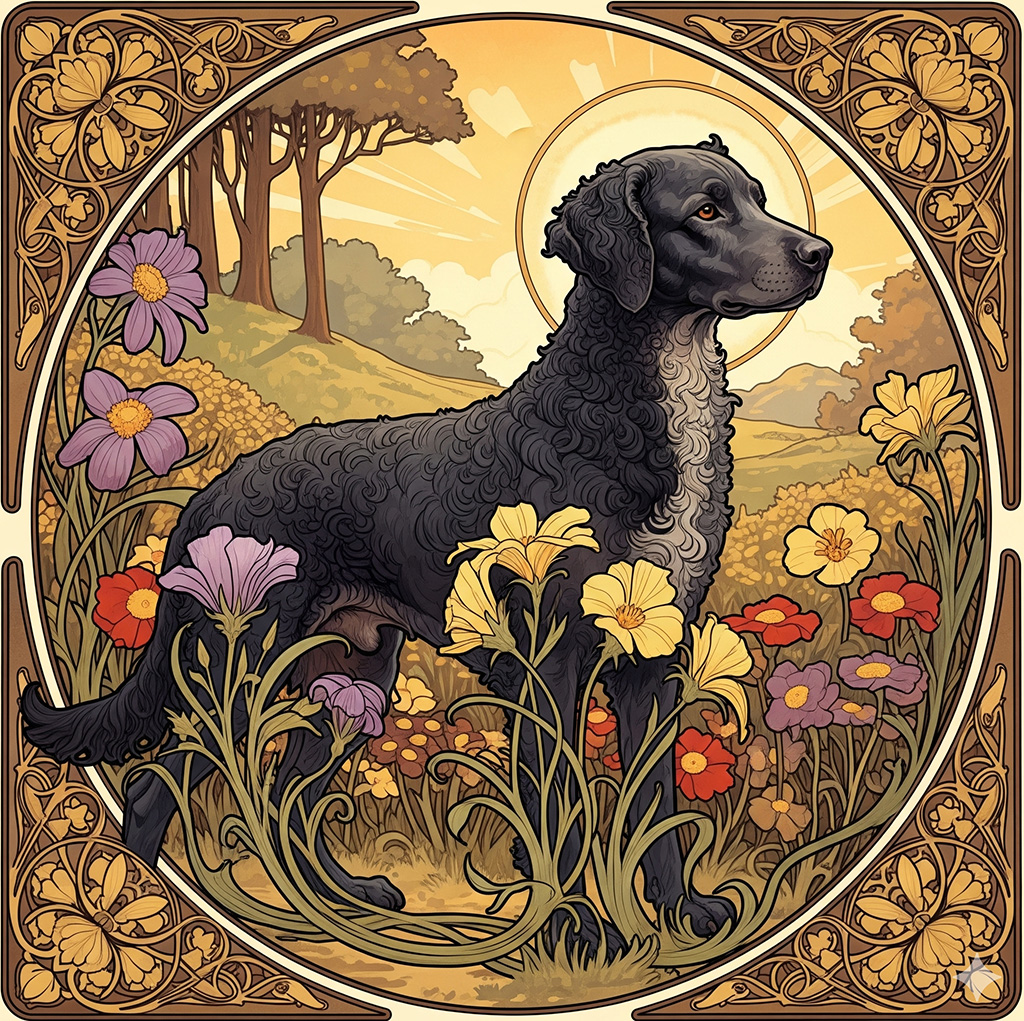
According to the American Kennel Club (AKC), the Curly-Coated Retriever is a poised, proud, and “wickedly smart” gundog, emphasizing balance, strength, and agility for all-day fieldwork. The breed standard describes a smartly upstanding dog with a graceful outline and elegant carriage. Males typically stand 25 to 27 inches at the withers, while females measure 23 to 25 inches, with a robust build that includes substantial bone without appearing coarse—more substantial than that of a Flat-Coated Retriever or Standard Poodle. The hallmark coat is a mass of small, tight, crisp curls covering the body, providing water resistance, while the face, front of legs, and feet feature short, smooth hair. Acceptable colors are solid black or liver, with minimal white hairs allowed on the chest but no full patches. The head is long and wedge-shaped, eyes are large and almond-shaped (black or brown depending on coat color), and the tail is carried straight. Temperamentally, the standard highlights loyalty, independence, and a biddable nature, though they can be stubborn and require experienced handling. Grooming is minimal, with males shedding once a year and females twice.
History of Hunting in the United States
The Curly-Coated Retriever arrived in the United States as early as the 1800s, with documented evidence from stud books and show entries confirming its presence before the turn of the century. However, the first officially recorded import occurred in 1907, and the breed gained AKC recognition in 1924. In the U.S., Curlies quickly earned a reputation as versatile gundogs, prized for their retrieving prowess in both water and upland settings, much like their English forebears. During the 1920s and 1930s, they surged in popularity among American hunters for their independent spirit, devotion, and ability to handle tough terrain and cold waters—qualities that made them ideal for duck and upland bird hunting. As part of the broader evolution of retrievers in North America, which adapted European breeds to local specialization, the Curly contributed to waterfowl conservation efforts through efficient game retrieval. Though never as widespread as Labradors, the breed’s “meat dog” heritage—stemming from early references to curly-coated water spaniels in the 15th century—endures among enthusiasts who value its historical role in sustainable hunting practices.
In summary, the Curly-Coated Retriever embodies a rich legacy of resilience and utility, from its English roots to its niche but dedicated following in American hunting circles. Its standards ensure the preservation of these working traits, making it a timeless choice for active owners.
-
A Labs First Day Afield
“No, I don’t think you understand, he has NO prior hunting experience…only obedience training.” I wrote to Brian, my new upland hunting buddy. The early morning email asking for my young lab and me to attend an upland hunt had caught me by surprise, putting a nice end to a long workweek. “Kali, it doesn’t…
-
The Lab Knows
Wyatt knows he’s black. He also knows this is the color of night. He’s been able to surmise that humans have terrible night vision. During daylight hours when we take breaks from hunting, he plots. He knows most mischief will not fly in the light of day. Raiding other camps, gnawing a nearby rotting deer…
-
Keeping Weight on Your Bird Dog
When we’re not in the field, my dogs get fed premium dog food twice a day. Normally I don’t even need a clock in the house because they start getting antsy when meal times near. I think this is why it’s so confounding that when we go hunting their interest in food is trumped…
-
Nowhere to Look
Dropped Wyatt off at the vet this morning for an exploratory procedure. I am now trying to do anything, accomplish something, will myself to the positive. I’m over-caffeinated and staged nearby awaiting the vet’s call. I can talk about the details, the minutia of his afflictions. I’ve gnashed over the could be and mights, in…
-
Pavlov Didn’t Have Bird Dogs
I’m forced to sneak about my own property like a burglar, held captive by bird dogs trying to secure their place in the truck. Regardless whether the destination is a wild place or the tame grocery, they are not willing to wager their spot. A few short weeks ago I could announce my exit to…
-
The Fountain of Youth
The old boy doesn’t leap into the truck like he once could, but he still manages to lurch up the running boards and cross the center console. Instead of stowing him in the back for this road trip, I break the rules and let him ride shotgun. He acknowledges the exemption and quickly curls into…