Braque Francais
The Braque Français, or French Pointer, stands as one of the oldest pointing dog breeds, renowned for its versatility in the field and gentle demeanor at home. Originating in southern France, this breed has a rich history tied to European hunting traditions, with two distinct types: the larger Gascogne and the smaller Pyrenean. Today, it continues to thrive as a capable gun dog, particularly in the United States where it has gained a dedicated following among upland bird hunters.
The breed’s origins trace back to the 1300s in the southwestern regions of France, where it was initially known as the “Braque du pays” or country Braque. Descended from ancient hound-like canines such as the oysel, developed along the Mediterranean flanks of the Pyrenees Mountains, the Braque Français evolved as a rustic pointing dog suited to rough terrain. By the 15th century, these dogs were documented for their natural pointing instincts, used to locate game birds for hunters in arid and mountainous areas. Historical accounts from the 1600s, including a 1683 description by Jacques Espee de Selincourt of the Gascogne type, highlight its role in pre-modern hunting, predating many short-haired pointing breeds. Regional isolation led to variations, and by the late 19th century, the breed faced near extinction due to crossbreeding and changing hunting practices. Revival efforts culminated in the formation of the first breed club in 1850 and the establishment of standards in 1880, formally dividing it into the Gascogne (Grande Taille) and Pyrenean (Petite Taille) types in the early 20th century, with name changes in 1975. The breed’s genetics influenced modern pointers, emphasizing endurance, scenting ability, and a cooperative hunting style.
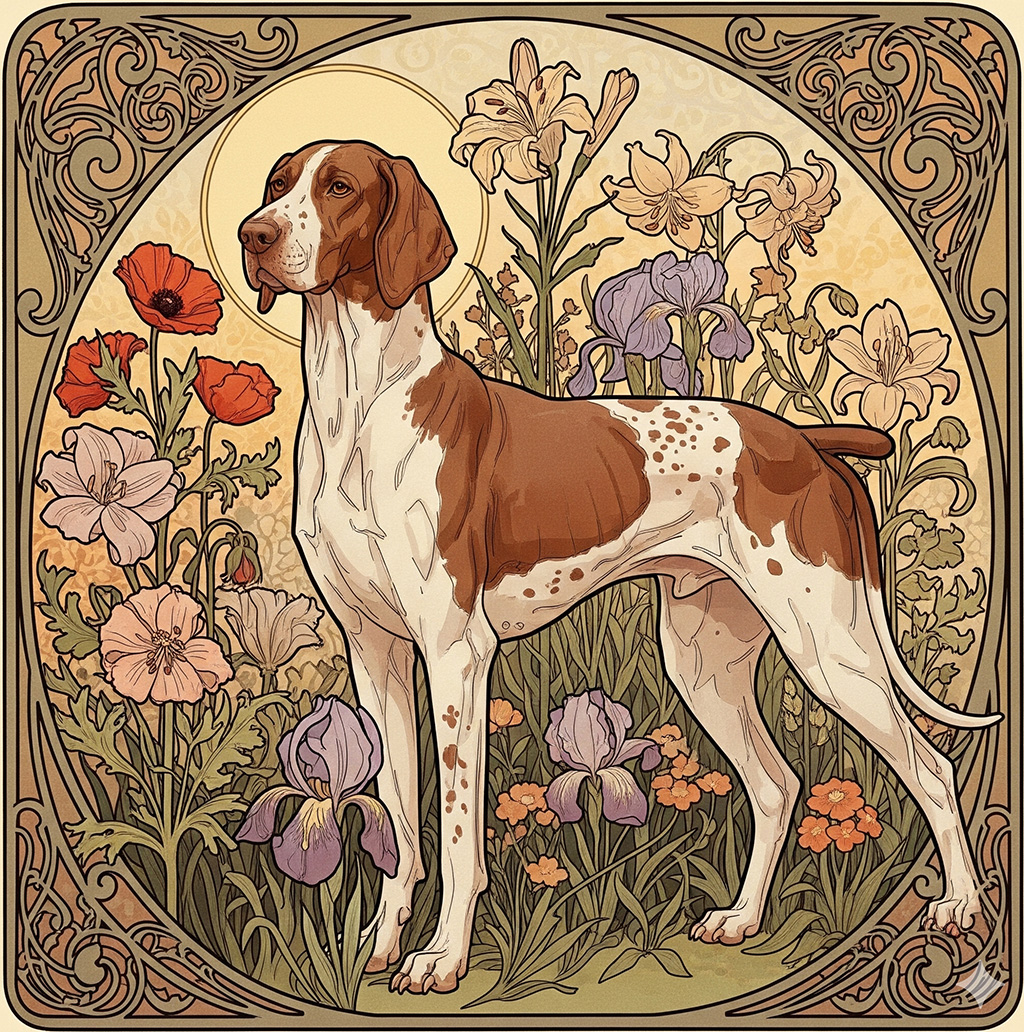
Breed standards, primarily set by organizations like the Fédération Cynologique Internationale (FCI) and adopted by bodies such as the American Kennel Club (AKC) for the Pyrenean type, emphasize a balanced, athletic build suited to versatile fieldwork. For the Pyrenean type, males measure 18.5 to 23 inches at the shoulder, females 18.5 to 22 inches, with a preferred range of 19.5 to 21.5 inches for optimal utility. The head features a chestnut-brown nose with well-opened nostrils, less pendulous lips than the Gascogne, and leathers set above the eye line, ending about 2 cm from the nose. Forequarters are lighter and muscular with moderately sloping shoulders, while hindquarters have tight feet for agility. The coat is short, typically white with chestnut spots or ticking, and the overall appearance is noble yet rustic. Faults include excessive weight, droopy lips, round eyes, or splayed feet, while eliminating faults encompass aggression, depigmentation, or structural defects like entropion. The Gascogne type is larger and more robust, but both prioritize a soft mouth, natural retrieve, and stamina for all-day hunting.
In the United States, the Braque Français has a relatively recent but growing history as a hunting companion, introduced in the early 1990s by enthusiasts like Brad Boisen, who began importing dogs from France in 1992 and established breeding programs focused on the Pyrenean variety. The Pyrenean type, the most prevalent in America, gained AKC recognition in 2016, following the Braque du Bourbonnais in 2011 and Bracco Italiano in 2001. Hunters value the breed for its acute sense of smell, which allows it to detect birds from afar, and its versatile style—pointing, flushing, retrieving, and trailing game in diverse terrains from South Dakota pheasant fields to Michigan grouse woods. Breeders such as Seth Leyendecker of Brielle Kennels, who acquired his first in 2010, praise their medium range (up to 250 yards), endurance, and family-friendly nature, making them ideal for both field and home. While not as widespread as German Shorthaired Pointers, the Braque Français has carved a niche among American upland enthusiasts for its trainability and reliability on species like quail, chukars, and woodcock.
In essence, the Braque Français embodies centuries of French hunting heritage, blending historical resilience with modern standards that ensure its prowess in the field. Its foothold in the United States underscores a timeless appeal for hunters seeking a devoted, efficient partner.
-
Pavlov Didn’t Have Bird Dogs
I’m forced to sneak about my own property like a burglar, held captive by bird dogs trying to secure their place in the truck. Regardless whether the destination is a wild place or the tame grocery, they are not willing to wager their spot. A few short weeks ago I could announce my exit to…
-
Rio Flufferbunny
It was fall when she came to us on a plane from New Mexico, all legs and ears and sharp puppy teeth. She pointed from the womb — butterflies, song birds, turtles, tufts of grass stirred by a breeze — nothing was safe from her glare. As our first setter, I was unsure of the…
-
A Labs First Day Afield
“No, I don’t think you understand, he has NO prior hunting experience…only obedience training.” I wrote to Brian, my new upland hunting buddy. The early morning email asking for my young lab and me to attend an upland hunt had caught me by surprise, putting a nice end to a long workweek. “Kali, it doesn’t…
-
Picking THE Puppy, or are we just kidding ourselves
Last time I chose a puppy I was fresh out of school, only a dim view of the years ahead and a bank account teetering on empty. At the time it seemed like a great idea, introduce a young dog into chaos and hope for the best. I knew little about training, obedience, nutrition, genetics,…
-
Nowhere to Look
Dropped Wyatt off at the vet this morning for an exploratory procedure. I am now trying to do anything, accomplish something, will myself to the positive. I’m over-caffeinated and staged nearby awaiting the vet’s call. I can talk about the details, the minutia of his afflictions. I’ve gnashed over the could be and mights, in…
-
The Lab Knows
Wyatt knows he’s black. He also knows this is the color of night. He’s been able to surmise that humans have terrible night vision. During daylight hours when we take breaks from hunting, he plots. He knows most mischief will not fly in the light of day. Raiding other camps, gnawing a nearby rotting deer…