Ring-Necked Pheasant
Also goes by: Ditch Chicken, Ringneck, Dragon Parrot
As the state bird of South Dakota, the Ring-necked Pheasant is the quintessential upland game bird. Yet, as American as apple pie as this bird may seem and as populous as it is across the states, it has its roots in Asia. In 1881, 21 Ringnecks were imported from Shanghai, China to Oregon. From there the birds flourished and within decades they could be found from coast to coast. As agricultural practices changed through out the 20th century, the Ring-necked Peasant found a niche in the changing habitat that enabled it to thrive without being discordant with the native species of the area. Today it is known for being one of the most hunted birds in the world.
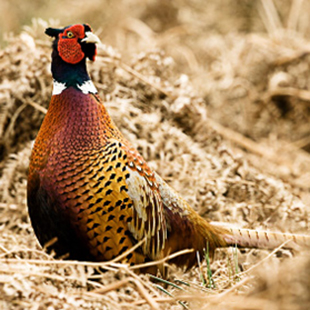
Because of captive breeding and the accompanying hybridization, there are many color variations of the male pheasant. A mature cock will have a red, bare face with an iridescent green head. This bird will have a white ring around his neck and a maroon neck. The birds flanks will have a tendency to be orange in color, though this may vary to be much whiter or, conversely, darker. A mature cock will be between 30 to 36 inches long, with at least half of its length being attributed to its long black-barred tail plumes. In actuality, the Ring-necked Pheasant will weigh less than three pounds.
These birds feed in the mornings and can be found in overgrown agricultural fields and cornfields. As the crops begin to be harvested they will push into thicker cover like marsh or woodlands. During the midday hours, these birds enjoy sunning themselves along hillsides or fencerows and field edges. The Ring-necked pheasants return to the fields in the afternoon for more feeding. At dusk they head for their roosting cover in the shrubs or high clover.
With approaching winter, this species will duck into the cover of willow and thickets, taking shelter from the wind. Ring-necked Pheasants are made more skittish with wind and it is important for both dog and hunter to attempt to utilize the direction – or constantly changing direction – of the wind to their advantage. Moving into the wind, can mask the hunter’s sound. Rain can also be advantageous, as it will cause these birds to hold tighter before flushing.
Hunting these birds with a close working, slower dog and a faster, wide-ranging dog can be advantageous when combing the fields. It is important to remember to take aim at the forward third of this bird because of its long tail. Many a shooter will make the mistake of aiming for the center of the target and actually hitting the tail. A 20 gauge with a modified choke is a superb choice in thick cover, but a 12 gauge is also very popular and excellent for the open fields of the West and Midwestern United States.
-
Pheasant Defying Drought….. For Now
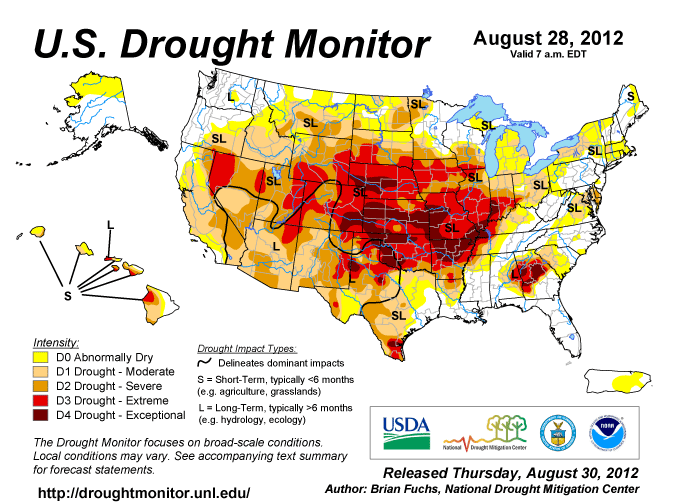
There has been a lot of news about the terribly dry conditions across the bulk of the country this year. This news sparked many early negative predictions for the upland populations. If you read much about the lifecycle of upland birds though, most don’t require much water when they are young. So unlike harsh winters…
-
Depths of Cold
There seems no bottom to the depths of cold. It’s one of the few solace for hunting in frigid condition: could be colder, windier, at least it’s not…more miserable. I’m assured by medical science that freezing does have a lower limit in terms of the human body. Paradoxical undressing: the point at which humans experiencing…
-
Inroads
We’ve been coming to this area of the grain belt for over 20 years. It took the locals at least seven of those to warm beyond a passing nod or the requisite finger waive to oncoming trucks. We now know many by name though most likely still recognize us only as familiar faces. Every year…
-
Bird Hunting Amid Spun Tales
Every year in Kansas we hear funny stories about birds and hunting. Maybe it was the full moon, the start of the whitetail rut or the dismal bird forecasts that contributed to tales of the extra nutty variety this season. We hunt from a small town that resides in a county with a population just…
-
Hunting in the Shadow of Roosevelt
When I hunt in North Dakota, my thoughts often drift to Teddy Roosevelt’s days at Elkhorn Ranch — He named his Dakota home for a pair of locked elk skulls he found at the site. Today, centrally located within the million acres of the Little Missouri National Grasslands, Elkhorn is a great place to visit…
-
The Last Bird: Living in the Upland Death Spiral
Most of the upland birds around here vanished during the Storm of the Century that dumped 30 inches of snow atop a base of frozen rain accompanied by -60° wind chill. Though game birds were on a downward trajectory long before that fateful day, the 43 years since have shown there’s little hope for any…