Wirehaired Pointing Griffon
The Wirehaired Pointing Griffon, often referred to as the Korthals Griffon, is a versatile and distinctive sporting breed renowned for its rugged appearance and exceptional hunting abilities. Its history, breed standards, and role as a gundog in the United States reflect a legacy of careful breeding and dedication to creating the ideal hunting companion.
Breed History
The Wirehaired Pointing Griffon’s origins trace back to the late 19th century, primarily credited to Eduard Karel Korthals, a Dutch sportsman and breeder who sought to develop the ultimate gundog. Beginning in the 1870s, Korthals worked in the Netherlands, Germany, and France, selectively breeding dogs to create a versatile hunter capable of working on varied terrains, including land and water. While the exact breeds used in its development remain uncertain, it is believed that Korthals crossed dogs such as the Otterhound, spaniels, setters, and pointers to achieve the desired traits. His efforts culminated in the establishment of the Ipenwoud kennel in Biebesheim am Rhein, Germany, where the breed’s type was solidified. By 1887, Korthals had produced three foundational dogs—Moustache I, Lina, and Querida—known as the “Korthals Patriarchs,” which formed the basis of the breed’s lineage.
In 1888, the Wirehaired Pointing Griffon became the first breed to have an official stud book, and an international club was formed to promote it, with regional clubs soon established in Bavaria, Belgium, and France. Despite Korthals’ untimely death in 1896 at age 44, his followers continued to uphold the breed standard set in 1897, ensuring its development across Europe. The breed’s early popularity grew in countries like France, Germany, and the Netherlands, where it was celebrated for its pointing and retrieving skills.
Breed Standards
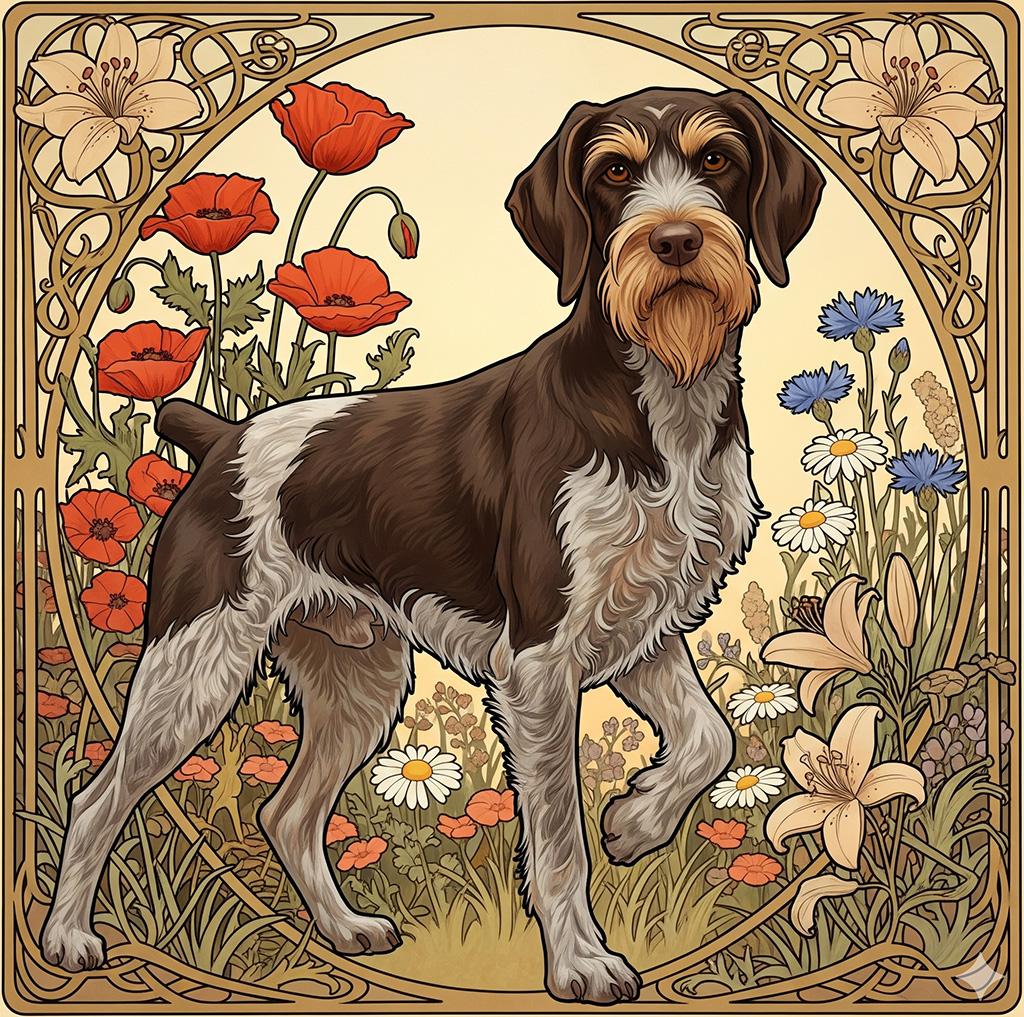
The Wirehaired Pointing Griffon is a medium-sized dog, with males standing 22–24 inches and females 20–22 inches, weighing 50–70 pounds and 35–50 pounds, respectively. Its defining feature is a harsh, wiry outer coat paired with a softer, insulating undercoat, designed to protect it in rough terrain and wet conditions. The coat is typically steel gray with brown markings, though chestnut brown, white and brown, roan, or white and orange are acceptable; black coats are disqualified. The breed’s appearance is characterized by a long, square head, large rounded eyes with an intelligent expression, and distinctive facial furnishings, including a mustache and eyebrows. The nose is always brown, and the body is muscular and well-proportioned, often with a docked tail in some countries.
According to the American Kennel Club (AKC) and United Kennel Club (UKC), the Griffon’s gait is efficient and cat-like, reflecting its stamina and grace as a hardworking gundog. The breed standard emphasizes a biddable, affectionate nature, making it both a skilled hunter and a suitable family companion. The French working standard highlights its unique pointing style, described as feline, with a tense, rigid body and extended neck when on point.
Hunting History in the United States
The Wirehaired Pointing Griffon first arrived in the United States in 1887, with a dog named Zolette registered in the AKC stud book, though mistakenly labeled as a “Russian Setter (Griffon)” due to the breed’s obscurity. It was not until 1916 that the AKC officially recognized the breed as the Wirehaired Pointing Griffon. Despite this early introduction, the breed remained relatively rare and struggled to gain traction among mainstream hunters, unlike other pointing breeds like the Brittany or German Shorthaired Pointer. Its popularity was hampered by challenges such as the decline of the breed in France during the World Wars and a dip in performance in the U.S. during the 1960s and 1970s, leading to its reputation as an “old man’s dog” due to fewer high-quality specimens.
In the U.S., the Griffon is valued for its versatility in hunting upland game birds and waterfowl. Its strong pointing instinct, keen nose, and water-repellent coat make it adept at working in diverse environments, from thickets to marshes. The breed’s methodical hunting style, often closer-ranging than faster breeds like English Setters, suits hunters on foot. However, concerns have arisen about deviations from Korthals’ original vision, with some lines reportedly crossed with English Setters, resulting in dogs with lighter coats and faster hunting styles. Efforts by groups like the American Wirehaired Pointing Griffon Association (AWPGA) and breeders like those at Shiok Ridge Kennel focus on preserving the breed’s authentic traits, emphasizing health, conformation, and hunting ability.
In recent decades, the Griffon has seen a resurgence in the U.S., with breeders and enthusiasts promoting its capabilities through field trials, hunt tests, and clubs like the Wirehaired Pointing Griffon Club of the Midwest. Notable achievements include dogs like Russell from Black Watch Griffons, who became the first Griffon to place in the AKC National Walking Field Trial Championship in 2022. The breed’s intelligence, eagerness to please, and stamina continue to make it a favorite among hunters seeking a loyal and versatile companion.
Conclusion
The Wirehaired Pointing Griffon is a testament to Eduard Korthals’ vision of a supreme gundog, blending rugged functionality with a friendly, intelligent disposition. Its carefully crafted breed standards ensure it remains a robust and adaptable hunter, while its history in the United States reflects both challenges and triumphs in maintaining its legacy. Today, the Griffon continues to thrive as a skilled hunting dog and devoted family companion, embodying the balance of work and affection that Korthals envisioned over a century ago.
-
The First Month with the New Puppy
Selective memory is a close ally to puppies. Recollection of puppy breath and cuddles gloss over the challenges of house training and toothy destruction. Adorable naps and puppy eyes erase the boundless energy and predawn bawling. It’s been six years since the last puppy, which has been plenty of time for revisionist history to mask…
-
Why We Hunt With Dogs
This morning I took my lab Wyatt out for a weekend stomp on public ground. Yesterday while in the field at first light I saw several other trucks with hunters trying to hunt the same field which we beat them to that day. Needless to say, the public options close to population centers here in…
-
Bird Dog Dealing with Lar Par
I’m not sure I can say “Laryngeal Paralysis” once correctly, let alone three times quickly — it’s a tongue twister. It has also been a vet stumper for a number of years. Until three weeks ago I had never heard of it. Let me break this diagnosis down in bird hunter terms which I’m certain…
-
Nowhere to Look
Dropped Wyatt off at the vet this morning for an exploratory procedure. I am now trying to do anything, accomplish something, will myself to the positive. I’m over-caffeinated and staged nearby awaiting the vet’s call. I can talk about the details, the minutia of his afflictions. I’ve gnashed over the could be and mights, in…
-
The Lab Knows
Wyatt knows he’s black. He also knows this is the color of night. He’s been able to surmise that humans have terrible night vision. During daylight hours when we take breaks from hunting, he plots. He knows most mischief will not fly in the light of day. Raiding other camps, gnawing a nearby rotting deer…
-
Meet Ida
I’ve always found the haphazard naming of dogs intriguing. I’ve wondered if a puppy grows into the name, filling the shape of some predetermined vessel? I like original names, probably because I have irrational hopes for my bird dogs to be uniquely exceptional. But then names different for different’s sake grind on me. People names…