Pudelpointer
The Pudelpointer, a versatile hunting breed, traces its origins to Germany in the late 19th century, born from a deliberate cross between the German hunting poodle (Pudel) and the English Pointer. In 1881, Baron von Zedlitz, a renowned German breeder, sought to create an ideal gun dog capable of tracking, pointing, and retrieving across diverse terrains, including fields, woods, and water. By combining the Pudel’s intelligence, water affinity, and retrieving instincts with the Pointer’s keen hunting drive, exceptional nose, and pointing ability, Zedlitz aimed to craft a dog that excelled in both field performance and companionship. The breeding program was meticulous, using only seven Pudels and over 90 Pointers to balance the stronger Poodle genes and achieve the desired traits. The foundation stock included a male English Pointer named Tell, owned by Kaiser Frederick III, and a German hunting Pudel named Molly, owned by Zedlitz. Over decades, this careful breeding established the Pudelpointer as a purebred dog with consistent characteristics, no longer requiring outcrosses to other breeds.
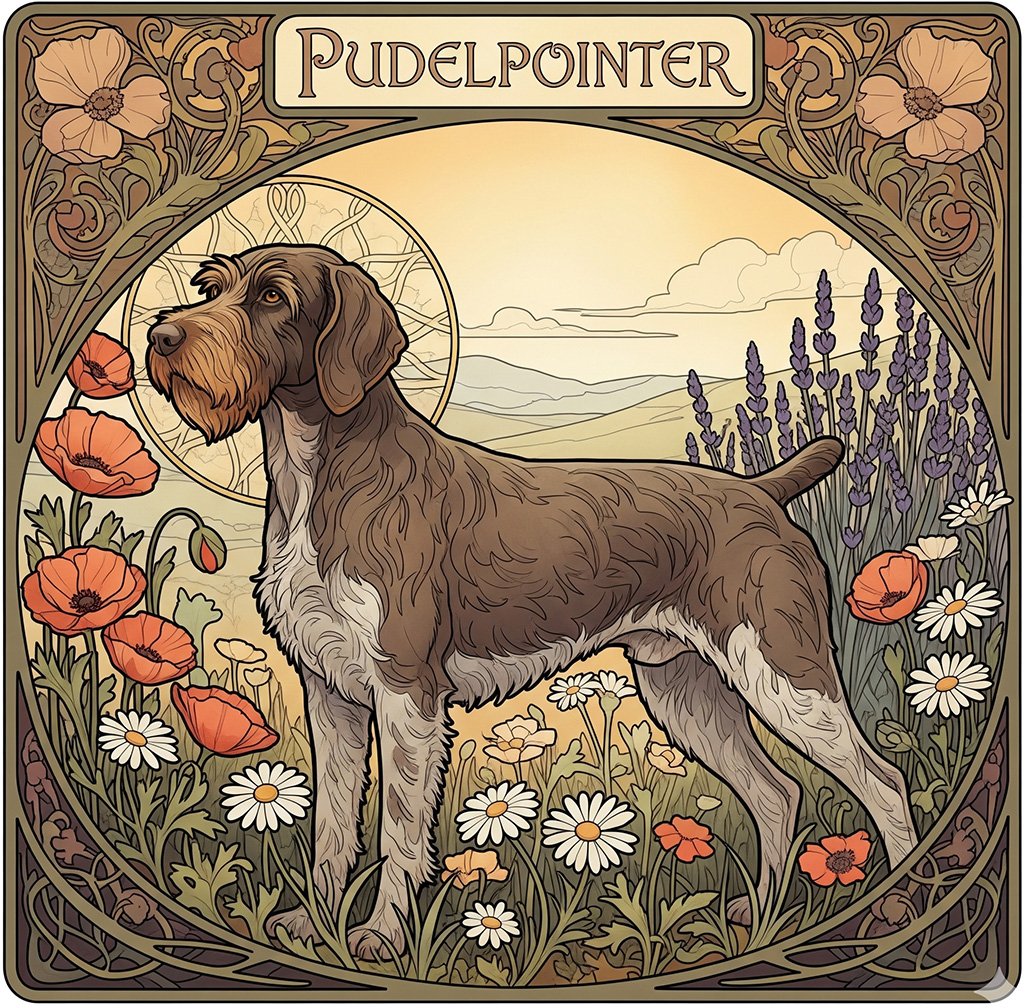
The Pudelpointer’s breed standards, as outlined by organizations like the United Kennel Club (UKC) and the North American Pudelpointer Society (NAPS), emphasize its role as a versatile working gun dog. The ideal Pudelpointer is medium to large, standing 21–26 inches at the shoulder and weighing 44–66 pounds. Its coat, a defining feature, is dense, harsh, and wiry, with a medium-length topcoat (1.5–2.5 inches) and a fine, woolly undercoat, protecting the dog in harsh weather and briars. Acceptable colors include liver, black, and dead leaf (a lighter brown), with minimal white markings permitted, such as a blaze on the chest. The coat may vary from smooth to rough or wiry, with the latter two preferred for breeding due to their suitability for colder climates and waterfowl hunting. The dog’s general appearance should convey agility, power, and nobility, with a flat, broad skull, large dark amber eyes, and medium-length ears that lie flat. A distinctive beard and forelock add to its rugged charm. Temperamentally, the Pudelpointer is calm, self-controlled, and intelligent, with a strong hunting instinct, free of shyness or aggression. Faults include solid white patches, overshot or undershot bites, and lack of a beard, while disqualifications involve conditions like albinism or entropion.
The Pudelpointer arrived in North America in 1956, introduced by H.D. Hume and Sigbot “Bodo” Winterhelt, the latter a German native who played a pivotal role in establishing the breed’s standards in the region. Winterhelt founded the Pudelpointer Club of North America (PCNA) in Canada in 1977, fostering interest among hunters. The breed gained traction in the United States, particularly among avid hunters, due to its versatility in pursuing upland birds, waterfowl, and small game. Recognized by the UKC in 2006 and enrolled in the American Kennel Club’s Foundation Stock Service in 2016, the Pudelpointer has remained relatively rare, with only about 200 puppies born annually in the U.S., most sold to active hunters. Breeders, supported by organizations like the PCNA, the North American Pudelpointer Alliance (NAPPA), and the Canadian American Pudelpointer Association (CAPA), prioritize performance through rigorous testing systems like the North American Versatile Hunting Dog Association (NAVHDA). These tests evaluate field, tracking, and water skills, ensuring breeding stock maintains the breed’s hunting prowess. NAPPA, in particular, enforces high standards, requiring breeders to actively hunt and test their dogs, contributing to a robust gene pool without outcrossing to other breeds.
In the United States, the Pudelpointer’s hunting legacy is upheld by a dedicated community of ethical breeders and hunters. Its ability to point, track, and retrieve across varied environments makes it a favorite for those seeking a single, all-purpose gun dog. While primarily a working breed, its intelligence, trainability, and friendly disposition also make it a loyal family companion, provided its high energy needs—requiring at least two hours of daily exercise—are met. The Pudelpointer’s history and standards reflect a commitment to preserving its exceptional hunting abilities, ensuring it remains a dynamic and reliable partner in the field for generations to come.
-
Rio Flufferbunny
It was fall when she came to us on a plane from New Mexico, all legs and ears and sharp puppy teeth. She pointed from the womb — butterflies, song birds, turtles, tufts of grass stirred by a breeze — nothing was safe from her glare. As our first setter, I was unsure of the…
-
Meet Ida
I’ve always found the haphazard naming of dogs intriguing. I’ve wondered if a puppy grows into the name, filling the shape of some predetermined vessel? I like original names, probably because I have irrational hopes for my bird dogs to be uniquely exceptional. But then names different for different’s sake grind on me. People names…
-
The Lab Knows
Wyatt knows he’s black. He also knows this is the color of night. He’s been able to surmise that humans have terrible night vision. During daylight hours when we take breaks from hunting, he plots. He knows most mischief will not fly in the light of day. Raiding other camps, gnawing a nearby rotting deer…
-
Pavlov Didn’t Have Bird Dogs
I’m forced to sneak about my own property like a burglar, held captive by bird dogs trying to secure their place in the truck. Regardless whether the destination is a wild place or the tame grocery, they are not willing to wager their spot. A few short weeks ago I could announce my exit to…
-
The First Month with the New Puppy
Selective memory is a close ally to puppies. Recollection of puppy breath and cuddles gloss over the challenges of house training and toothy destruction. Adorable naps and puppy eyes erase the boundless energy and predawn bawling. It’s been six years since the last puppy, which has been plenty of time for revisionist history to mask…
-
Keeping Weight on Your Bird Dog
When we’re not in the field, my dogs get fed premium dog food twice a day. Normally I don’t even need a clock in the house because they start getting antsy when meal times near. I think this is why it’s so confounding that when we go hunting their interest in food is trumped…