Italian Spinone
The Italian Spinone, known for its distinctive wiry coat and gentle temperament, is one of the oldest gun dog breeds, with a rich history rooted in Italy’s rugged landscapes. Its origins trace back to at least the Renaissance period, with references to coarse-haired hunting dogs in Italian literature and art from the 15th century. Some historians suggest the breed descends from ancient European griffon-like dogs, possibly influenced by crosses with setters, pointers, and even hounds brought by traders or invaders. By the 19th century, the Spinone Italiano, as it is known in its homeland, was refined in the Piedmont region of northern Italy, bred for its versatility in navigating marshes, forests, and hilly terrain to hunt game such as quail, pheasant, and waterfowl.
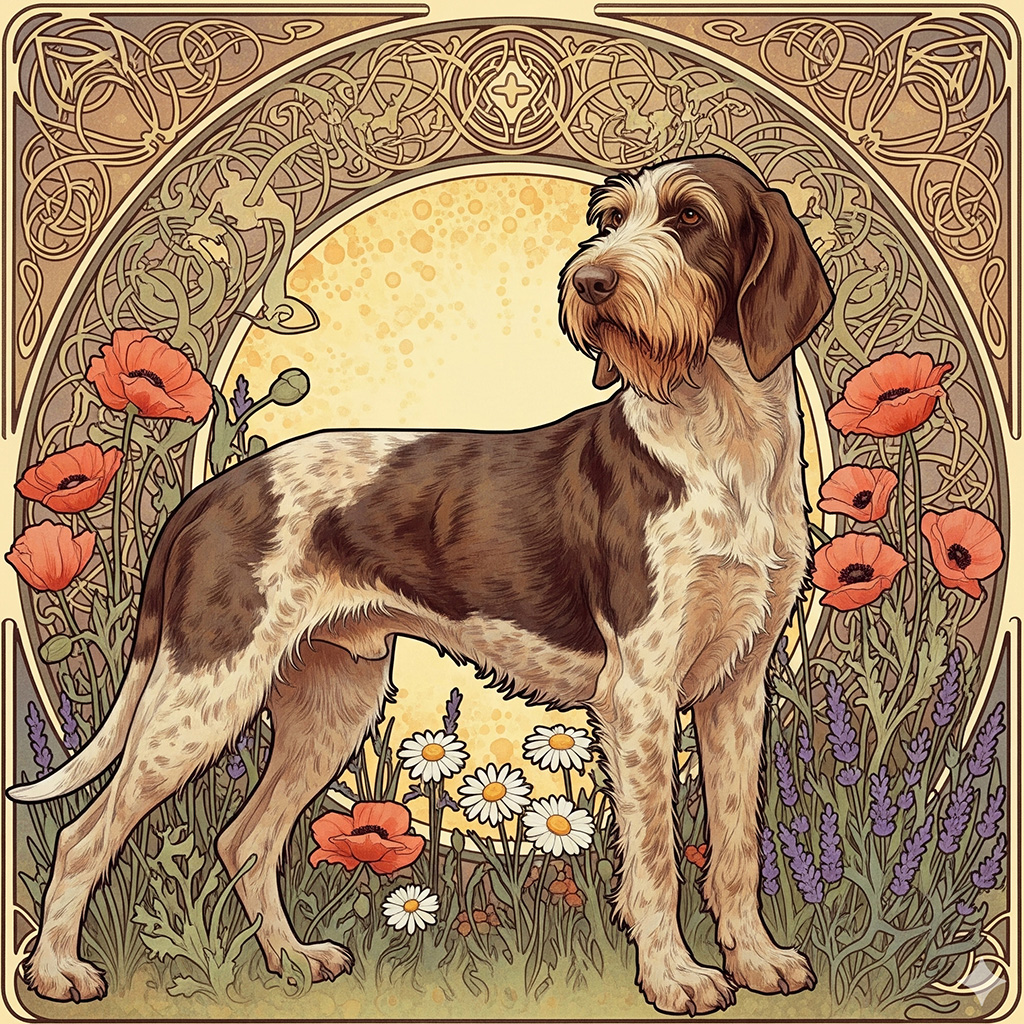
The Italian Spinone’s breed standard, as recognized by organizations like the American Kennel Club (AKC) and the Fédération Cynologique Internationale (FCI), emphasizes its robust, muscular build and distinctive appearance. The standard calls for a dog standing 23–27 inches tall at the shoulder for males and 22–25 inches for females, with a weight range of 61–85 pounds. The coat is dense, wiry, and weather-resistant, typically white, white with orange or brown markings, or roan patterns. The head is long, with a pronounced occiput, soulful eyes, and a beard that gives the breed its characteristic expressive face. Temperamentally, the Spinone is described as docile, patient, and sociable, making it an excellent companion as well as a working dog. The breed’s movement is a steady, purposeful trot, reflecting its endurance for long hunts. The standard prioritizes functionality, with a body built for stamina rather than speed, and a keen nose for tracking.
In the United States, the Italian Spinone’s history as a hunting dog began in earnest in the late 20th century. While the breed was relatively unknown in America until the 1980s, its introduction coincided with growing interest in versatile European hunting breeds. The Spinone’s ability to point, retrieve, and work in varied terrains—particularly wetlands—made it appealing to American hunters. The breed was officially recognized by the AKC in 2000, following the establishment of the Spinone Club of America in 1987, which promoted its use in field trials and hunt tests. Unlike flashier pointing breeds like the English Setter, the Spinone’s methodical approach and calm demeanor suited hunters seeking a reliable partner for upland game and waterfowl. Its soft mouth and natural retrieving instincts were particularly valued for delivering game undamaged.
Today, the Italian Spinone remains a niche but cherished breed in the U.S. hunting community. Its versatility extends beyond the field, with many Spinoni excelling in therapy work and as family pets due to their gentle nature. However, the breed’s population remains small, with only a few hundred registered annually by the AKC, reflecting its status as a specialized working dog. Efforts by breed enthusiasts and clubs continue to preserve its hunting heritage, ensuring the Spinone’s legacy as a skilled and soulful companion endures in America’s fields and homes.
-
Pavlov Didn’t Have Bird Dogs
I’m forced to sneak about my own property like a burglar, held captive by bird dogs trying to secure their place in the truck. Regardless whether the destination is a wild place or the tame grocery, they are not willing to wager their spot. A few short weeks ago I could announce my exit to…
-
Bird Dog Dealing with Lar Par
I’m not sure I can say “Laryngeal Paralysis” once correctly, let alone three times quickly — it’s a tongue twister. It has also been a vet stumper for a number of years. Until three weeks ago I had never heard of it. Let me break this diagnosis down in bird hunter terms which I’m certain…
-
Rio Flufferbunny
It was fall when she came to us on a plane from New Mexico, all legs and ears and sharp puppy teeth. She pointed from the womb — butterflies, song birds, turtles, tufts of grass stirred by a breeze — nothing was safe from her glare. As our first setter, I was unsure of the…
-
A Labs First Day Afield
“No, I don’t think you understand, he has NO prior hunting experience…only obedience training.” I wrote to Brian, my new upland hunting buddy. The early morning email asking for my young lab and me to attend an upland hunt had caught me by surprise, putting a nice end to a long workweek. “Kali, it doesn’t…
-
Meet Ida
I’ve always found the haphazard naming of dogs intriguing. I’ve wondered if a puppy grows into the name, filling the shape of some predetermined vessel? I like original names, probably because I have irrational hopes for my bird dogs to be uniquely exceptional. But then names different for different’s sake grind on me. People names…
-
The Lab Knows
Wyatt knows he’s black. He also knows this is the color of night. He’s been able to surmise that humans have terrible night vision. During daylight hours when we take breaks from hunting, he plots. He knows most mischief will not fly in the light of day. Raiding other camps, gnawing a nearby rotting deer…