Drahthaar
The Deutsch-Drahthaar, often simply called the Drahthaar, is a versatile hunting dog breed originating in Germany during the late 19th century. Developed to meet the demands of German hunters seeking a single dog capable of performing multiple tasks across diverse terrains, the Drahthaar emerged through careful crossbreeding of existing coarse-haired breeds like the Stichelhaar, Pudelpointer, Griffon, and the Deutsch-Kurzhaar (German Shorthaired Pointer). The goal was to create a dog adept at pointing, tracking, and retrieving game in field, forest, and water, with a robust constitution and a weather-resistant coat. In 1902, the Verein Deutsch-Drahthaar (VDD) was founded under the leadership of Freiherr Sigismund von Zedlitz und Neukirch, known as Hegewald, who championed the principle of “through performance to standard.” This philosophy prioritized hunting ability over appearance, shaping the breed’s development through rigorous performance testing and strict breeding regulations.
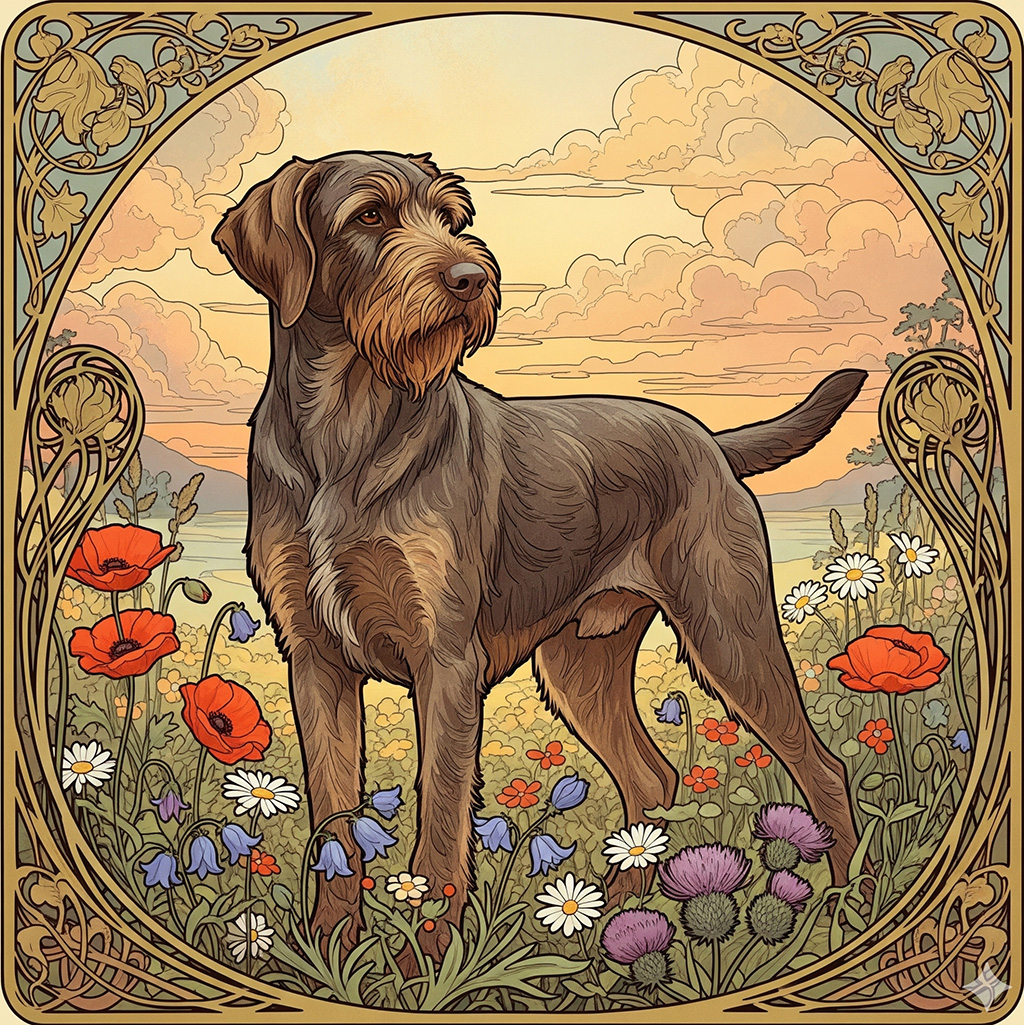
The Drahthaar’s breed standard reflects its functional design. Males stand 61–68 cm at the shoulder, females 57–64 cm, with a medium to large, well-muscled build. The hallmark wiry, dense coat with a thick undercoat protects against harsh weather, thorns, and brush, making it ideal for demanding hunting conditions. Coat colors include liver roan, black roan, or solid liver, with distinctive facial features like a beard and eyebrows enhancing its rugged appearance. The standard emphasizes health, temperament, and hunting prowess, requiring dogs to pass tests like the VJP (spring puppy test), HZP (fall breed test), and VGP (utility test) to ensure traits such as pointing, tracking, and retrieving are preserved. Dogs displaying excessive aggression or anxiety are excluded from breeding to maintain a calm, intelligent, and family-friendly temperament.
Introduced to the United States in the 1920s, the Drahthaar gained traction among hunters for its versatility. The German Drahthaar Club of America, formed in 1953, and later the VDD-Group North America (VDD-GNA) in 1971, upheld the German breeding standards, distinguishing the Drahthaar from the American-bred German Wirehaired Pointer (GWP). While the GWP, recognized by the American Kennel Club in 1959, shares Drahthaar ancestry, it diverged due to less stringent breeding regulations, focusing more on appearance than performance. In the U.S., Drahthaars excel in upland game and waterfowl hunting, leveraging their stamina, sensitive nose, and ability to track wounded game, such as pheasants or deer, under challenging conditions. Their popularity grew as hunters valued a dog that could handle diverse game and terrains without needing multiple specialized breeds.
Today, the Drahthaar remains a top choice for serious hunters in the U.S., particularly those affiliated with organizations like the VDD-GNA, which ensures adherence to German standards through testing and health screenings for conditions like hip dysplasia. Beyond hunting, Drahthaars are loyal family companions, gentle with children when socialized, though their high energy demands regular exercise to prevent destructive behavior. The breed’s legacy in the U.S. reflects its German roots: a commitment to versatility, endurance, and intelligence, making it a standout among sporting dogs.
-
Picking THE Puppy, or are we just kidding ourselves
Last time I chose a puppy I was fresh out of school, only a dim view of the years ahead and a bank account teetering on empty. At the time it seemed like a great idea, introduce a young dog into chaos and hope for the best. I knew little about training, obedience, nutrition, genetics,…
-
Pavlov Didn’t Have Bird Dogs
I’m forced to sneak about my own property like a burglar, held captive by bird dogs trying to secure their place in the truck. Regardless whether the destination is a wild place or the tame grocery, they are not willing to wager their spot. A few short weeks ago I could announce my exit to…
-
Keeping Weight on Your Bird Dog
When we’re not in the field, my dogs get fed premium dog food twice a day. Normally I don’t even need a clock in the house because they start getting antsy when meal times near. I think this is why it’s so confounding that when we go hunting their interest in food is trumped…
-
The Lab Knows
Wyatt knows he’s black. He also knows this is the color of night. He’s been able to surmise that humans have terrible night vision. During daylight hours when we take breaks from hunting, he plots. He knows most mischief will not fly in the light of day. Raiding other camps, gnawing a nearby rotting deer…
-
Rio Flufferbunny
It was fall when she came to us on a plane from New Mexico, all legs and ears and sharp puppy teeth. She pointed from the womb — butterflies, song birds, turtles, tufts of grass stirred by a breeze — nothing was safe from her glare. As our first setter, I was unsure of the…
-
Why We Hunt With Dogs
This morning I took my lab Wyatt out for a weekend stomp on public ground. Yesterday while in the field at first light I saw several other trucks with hunters trying to hunt the same field which we beat them to that day. Needless to say, the public options close to population centers here in…